Finding the Right Wetsuit Size: How to Check the Fit Properly
Finding the right wetsuit size is harder than for almost any other item of clothing. A wetsuit should fit snugly but not constrict. It should keep you warm but not hold back your breathing. And what seems “pretty much okay” in the shop can sometimes feel completely different after 30 minutes in the water.
We at FlipSoc talk to lots of surfers, triathletes and swimmers every season. One observation keeps coming up: people who curse when putting their suit on often aren’t wearing a “difficult” suit, but simply the wrong size. The fit determines warmth, freedom of movement, durability – and how much energy you leave in the car park before every session.
In this guide you’ll learn which measurements really count, how to read a size chart, how to recognise a good fit when trying it on and what to do if your wetsuit is too tight or too loose.
In short: The right wetsuit size is determined by height, weight, chest and waist measurements according to the manufacturer’s chart. When you try it on, a good wetsuit fits like a second skin: snug, with no wrinkles or water pockets, with sealing cuffs and free breathing. Between two sizes, the fitting decides, not the label.
Which measurements do you need for the right wetsuit size?
For your wetsuit size you need four values: height, weight, chest circumference and waist circumference. Almost all manufacturers base their size charts on these figures. Your usual clothing size for T-shirts or jeans, on the other hand, is only of limited help.
The reason: a wetsuit encloses the whole body. It has to match the length of your torso, the circumference of your chest and your build all at the same time. Two people with the same shirt size can therefore need different wetsuit sizes.
How to measure yourself correctly
- Height: Stand barefoot with your back against a wall, head straight, mark the highest point and measure.
- Weight: In the morning, without clothes, on normal bathroom scales – that way you get a stable reference value.
- Chest circumference: Run the tape measure horizontally under your armpits around the widest part of your chest. Breathe out normally, don’t hold your breath.
- Waist circumference: Measure at the narrowest part of your torso, usually just above the belly button. Don’t pull your stomach in.
- Optional hips and inside leg: Some charts, especially for women’s wetsuits, also give the hip circumference. The inside leg length helps if you have very long or short legs.
Write down the values and ideally measure twice. A measuring error of just a few centimetres can make the difference between two sizes.
How do you read a wetsuit size chart correctly?
It’s best to read a wetsuit size chart starting from height and weight, then check chest and waist. Height and weight give you the rough direction; the circumferences decide the fine-tuning.
Important: size charts are manufacturer-specific. One brand’s “M” can be cut quite differently from another brand’s “M”. Many manufacturers also offer in-between sizes, for example for tall, slim or short, stocky bodies. These often carry additions such as “T” for “tall” or “S” for “short”.
| Situation | How to recognise it | Recommendation |
|---|---|---|
| All values in one size | Height, weight, chest and waist are all in the same range | Take this size and confirm it when trying it on |
| Height fits, weight is higher | You’re more strongly built than average for your height | Pay attention to chest and waist, choose an in-between size if necessary |
| Weight fits, height is higher | You’re tall and slim | Look for a long version (“tall”), otherwise the suit will be too short in the crotch |
| Between two sizes | Individual values cross the boundary | Try on both sizes; if in doubt, the size in which your shoulders and breathing are free |
The intended use also plays a role. Swimming and triathlon wetsuits are particularly flexible at the shoulders and usually fit very tightly so that no water flows through. Surf wetsuits can allow a little more room for movement. You’ll find more on the differences between suit types in our basics on neoprene and wetsuits.
How do you recognise a good wetsuit fit?
You can recognise a good fit by the wetsuit sitting like a second skin: snug everywhere, but without pressure points, wrinkles or water pockets. A little material under the armpits is normal and provides freedom of movement for paddling or front crawl.
Neoprene insulates because only a very thin layer of water forms between skin and suit, which your body warms up. If the suit is too loose, this water is constantly being replaced. Then you get cold – no matter how thick the material is.
The 5-minute fitting check
- Neck: The neck seal sits flush all round without choking you. You can swallow normally and turn your head.
- Breathing: Take three deep breaths into your belly and chest. If it feels like a corset, the wetsuit is too tight.
- Shoulders: Stretch your arms above your head and circle them. The suit can offer resistance but mustn’t pull you down.
- Crotch: No air space between crotch and suit. If the crotch sags, the wetsuit is too long or you haven’t pulled it up far enough.
- Back: No fold or bulge should form in the lower back – otherwise water will collect there later.
- Knees: The knee pads sit on the knee, not above or below it.
- Cuffs: At the wrists and ankles the suit seals tightly without cutting in.
- Movement: Squat down, simulate a paddling or front crawl movement. Nothing should pull, pinch or slow you down.
Important: only check the fit once the suit is really sitting correctly. Many people don’t pull their wetsuit up far enough and then think it’s too small. We explain in detail how to put it on correctly step by step in our guide to putting on a wetsuit.
What to do if the wetsuit is too tight?
If the wetsuit is too tight, you should exchange it or go one size up as soon as your breathing or shoulder mobility is restricted. A slight feeling of tightness on land, on the other hand, is normal and often eases in the water.
Typical signs of a wetsuit that’s too small are:
- You can’t get enough air when breathing in deeply.
- Your arms get heavy after a few minutes of paddling or front crawl.
- The zip can only be closed with a lot of force.
- The neck seal presses so hard that pressure marks form.
- Arms and legs end well above the wrists and ankles.
A wetsuit stretches slightly over time. But relying on a clearly too-small suit to “stretch out eventually” is risky. The stretch is enough for a bit more comfort, not for a whole size.
What to do if the wetsuit is too big?
If the wetsuit is too big, an exchange is usually the best solution, because water pockets can’t be trained away. A wetsuit that’s too loose costs you warmth and, when swimming, speed too, because water is carried along inside the suit.
You can recognise a wetsuit that’s too big by wrinkles on the stomach and lower back, a sagging crotch, sleeves and legs that slip over your hands and feet, and cuffs that don’t seal tightly. In the water you’ll then feel the typical “flush”: with every movement, cold water rushes into the suit over your back or neck.
On some suits you can have slightly too-long arms or legs shortened. But that’s a job you should leave to a specialist workshop. It won’t help with a chest that’s too wide or a torso that’s too big.
Why does a wetsuit that’s too small make putting it on a nightmare?
A wetsuit that’s too small makes putting it on a nightmare because the material has to be stretched more and therefore grips the skin with more pressure. More pressure means more friction – and that’s exactly what slows you down at every centimetre as you push it up.
Many people know the consequences from experience: you tug at the cuffs with all your strength, your fingernails leave marks in the neoprene, your back complains, and after five minutes you’re standing sweaty on the beach. That’s not just annoying. Constant tugging at edges and seams is also one of the most common causes of tears and stretched-out cuffs.
There’s also an amplifier: wet or sweaty skin brakes even more. If you struggle into a very tight suit after warming up, you have it twice as hard. And thick winter suits are inherently stiffer – a size that’s too small has a particularly strong effect with them. We explain why in the guide to wetsuit thickness by water temperature.
Conversely: a size that really fits is much easier to put on than one that’s too small. If you’re torn between two sizes and are already struggling with the smaller one on land, take that seriously.
How tight can a triathlon or swim wetsuit be?
A triathlon or swim wetsuit can and should fit tighter than a surf wetsuit, as long as breathing and arm stroke remain free. It has to be comfortable for front crawl over long distances and mustn’t take on water with every movement.
With swim wetsuits, the shoulder area is usually made of particularly thin, stretchy material. So be sure to test the front crawl movement when trying it on: stretch your arm far forward, circle it, pull through to the back. If you feel the suit pulling your arm back, first check whether it’s pulled up far enough at the upper arm and shoulder – that’s often where the problem lies, not in the size.
You’ll find tips on swimming in a wetsuit, from body position in the water to breathing, in our guide to swimming in a wetsuit.
What role do gender, age and body shape play?
Gender, age and body shape influence the cut of the suit more than the size label alone. That’s why there are special women’s, men’s and children’s cuts as well as in-between sizes.
- Women’s wetsuits are cut differently at the chest, waist and hips and are usually narrower at the shoulders. A men’s wetsuit therefore often only fits women with water pockets.
- Children’s wetsuits should fit, not be bought “to grow into”. A children’s wetsuit that’s too big gets cold and isn’t fun.
- Very muscular upper bodies often need a larger size at the chest and shoulders, even though weight and height suggest a smaller one.
- Long torsos notice a size that’s too short first at the crotch and the neck seal, which pulls downwards.
Typical mistakes when buying a wetsuit
- Buying only by clothing size: “I wear M, so I’ll take M” often goes wrong with a wetsuit.
- Buying too small because “tight = warm”: Tight, yes, but breathing and movement must stay free.
- Buying too big because it’s easier to put on: Putting it on is easier then, but you’ll be cold in the water.
- Trying it on standing still: A wetsuit has to fit in motion, not in front of the mirror.
- Suit not pulled up completely: Then it seems too small, even though the size is right.
- Comparing size charts from different manufacturers: Each chart only applies to its own cut.
How to make putting it on easier even with a tight fit
A good, snug fit and easy dressing aren’t mutually exclusive. What matters is reducing the friction between skin and neoprene. Classic helpers are a thin plastic bag or a sock over your foot and hand so the leg slides through the cuff more easily. That works, but the bag tends to tear and ends up in the bin.
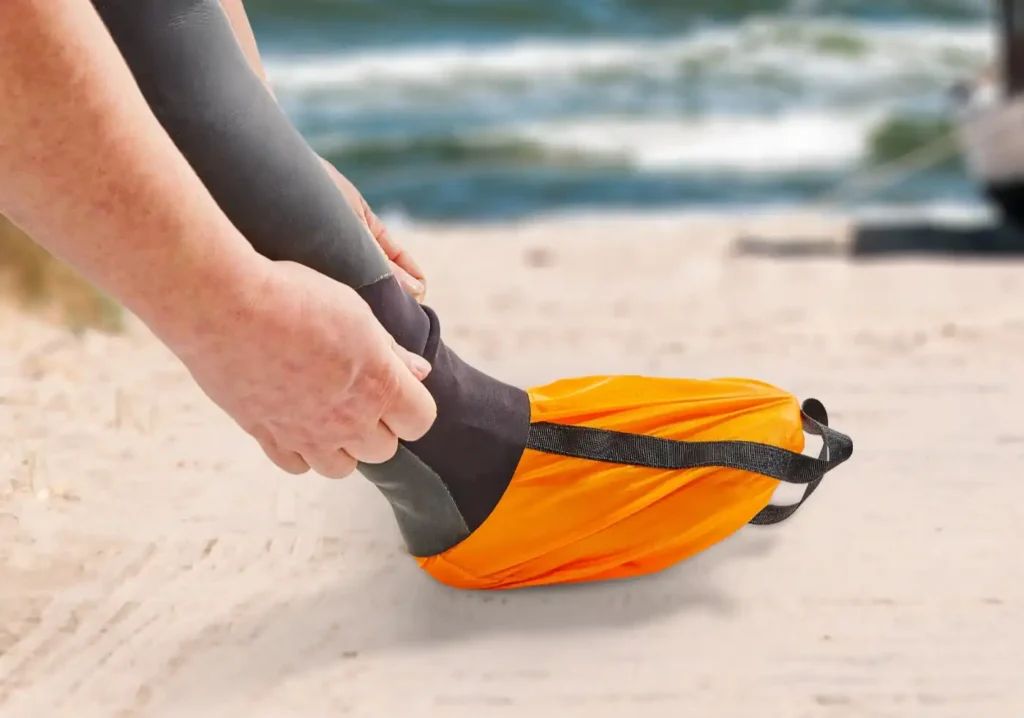
That’s exactly where FlipSoc comes in. You pull this dressing aid made of smooth ripstop nylon over your foot or hand, slip into the leg or sleeve, and the neoprene glides over the nylon through the cuff instead of sticking to your skin. This works wet or dry and with all suit thicknesses and sizes.
Especially with tight-fitting swimming and triathlon wetsuits or thick winter suits, you’ll notice the difference at the cuffs: less tugging, less strain on the seams, more energy for the session. One limitation, to be honest: FlipSoc is made for classic wetsuits with a jersey-lined interior. It is not suitable for smoothskin or open-cell suits, as commonly used in freediving, where the inside is bare, rubbery neoprene that sticks to the skin.
And one more point: a dressing aid doesn’t make the wrong size right. It helps you put on a snug, well-fitting suit gently – it shouldn’t gloss over a wetsuit that’s far too small.
Frequently asked questions about wetsuit size
Should I go a size smaller or larger with a wetsuit?
That depends on where you fall between the sizes. Choose the size in which you can breathe freely and stretch your arms above your head without wrinkles or water pockets forming. If in doubt, the fitting decides, not the chart.
How tight should a wetsuit be?
A wetsuit should fit like a second skin: snug all round, without wrinkles and with sealing cuffs at the neck, hands and feet. At the same time, breathing and shoulder mobility must not be restricted. A little material under the armpits is normal.
Does a wetsuit stretch over time?
Yes, a wetsuit stretches slightly over time, especially in areas under heavy strain. But the stretch is only enough for a little more comfort. A wetsuit that’s clearly too small won’t end up fitting.
Can I wear a men’s wetsuit as a woman?
It’s possible, but often with compromises. Men’s wetsuits are wider at the shoulders and cut differently at the hips and chest, so many women end up with water pockets. A women’s cut usually fits better and therefore keeps you warmer.
Why is my new wetsuit so hard to put on?
New wetsuits are often still a little stiff, and a snug fit increases friction on the skin. Put the suit on in small sections from the bottom up and reduce the friction at the cuffs, for example with a dressing aid. If you’re still fighting for every breath on land, check whether the size is right.
Conclusion
You’ll find the right wetsuit size with four measurements, the size chart of the respective manufacturer and a thorough fitting in motion. A good wetsuit fits snugly like a second skin but lets you breathe freely and paddle or swim front crawl. Too loose costs warmth; too tight costs nerves, energy and, in the long run, material too.
Take your time with the fitting, pull the suit up completely and test the movements of your sport. Then you’ll enjoy your wetsuit for many years.
So that even a snug suit glides over your feet and hands without tugging at the cuffs, try FlipSoc as a dressing aid for your wetsuit – with free shipping and free returns within 14 days.